
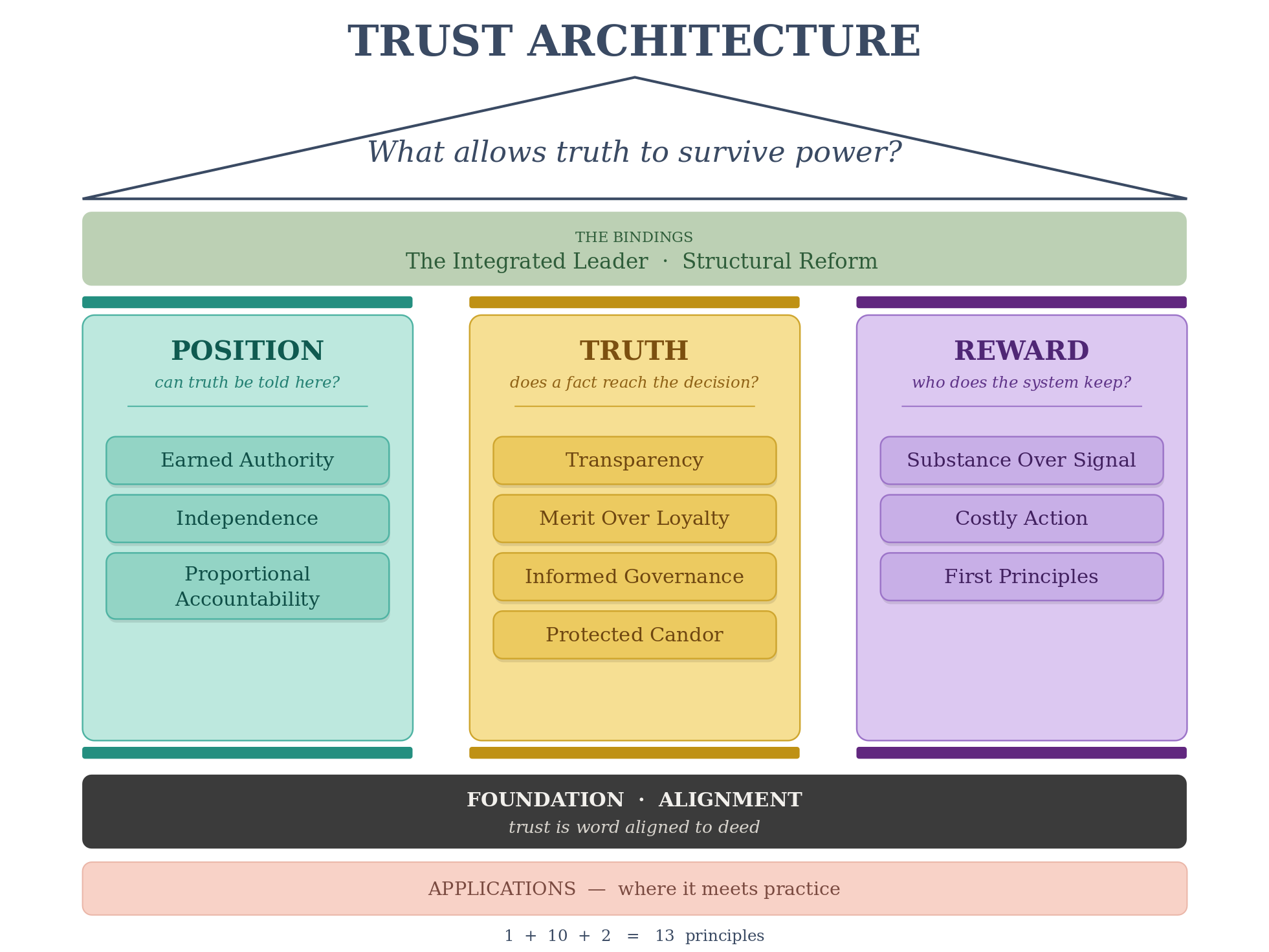
Every organization believes it values the truth until the truth becomes expensive. Trust Architecture is a framework for building organizations where the truth survives contact with power. It has a shape: a foundation, three pillars, and two bindings thirteen principles in all. This page is the whole map. Each principle links to a short essay that teaches it: what it means, a moment from history, and a question you can ask of your own organization. Start anywhere, or follow it in order.
The fixed question: What allows truth to survive power?
Foundation
Alignment — Trust is the demonstrated match between word and deed: proven over time, never merely declared. (the base everything rests on)
Pillar I · Position — can truth be told here?
Earned Authority — Decision rights come from demonstrated competence, not from a title.
Independence — The function that judges a risk reports outside the chain that owns it.
Proportional Accountability — You can hold someone answerable only for what they had the authority to control.
Pillar II · Truth — does a fact reach the decision?
Transparency — Competence and decisions stay open to examination, not shielded by rank.
Merit Over Loyalty — Trust is earned by performance and never demanded as loyalty.
Informed Governance — Those who govern get an independent line of sight, not an edited summary.
Protected Candor — Telling the truth — and standing by whoever did — is survivable.
Pillar III · Reward — who does the system keep?
Substance Over Signal — The system rewards what leadership produces over what it projects.
Costly Action — Leaders are judged by what they do at a price to themselves, not what they say for free.
First Principles — Inherited structures are rebuilt from what they’re for, not kept because they’re inherited.
The Bindings — what holds it together and makes it last
The Integrated Leader — The person who can fight, build, and design at once, and knows which the moment demands.
Structural Reform — Failures are treated as faults of design, not character — so the system, not the scapegoat, gets fixed.
Applications
Where the architecture meets practice a diagnostic you can run on your own organization, one principle at a time.
The Specification
For the precise version: Trust Architecture — Specification One page per principle the condition, what it means, the failure it prevents, how it holds truth against power, how it connects to the others, and a test for your own organization. This is the canonical reference the essays teach from.
New here? Start with the manifesto the question this all answers.