
Trust Architecture
What allows truth to survive power?
Every organization believes it values the truth, until the truth becomes expensive. Then something quiet happens: a warning gets softened at each level it passes through, by people who each had a reasonable reason, and over time the people best equipped to sound the alarm learn that candor costs them and comfort pays. An organization doesn’t go blind because its people stopped caring. It goes blind because telling the truth became a bad career decision.
We usually call that a failure of character, weak people, bad leaders. It isn’t. It’s a failure of design. And a design can be rebuilt.
Trust Architecture is a framework for building organizations where the truth survives contact with power. Trust isn’t a feeling or a value to be summoned; it’s a structure a foundation, three pillars (Position, Truth, and Reward), and two bindings that hold the whole thing together. Thirteen principles in all, each a specific condition under which truth survives, and each, when violated, a specific way an organization learns to look away.
This publication teaches that framework one principle at a time: a short essay, a piece of history, and a question you can ask of your own organization. One idea per issue, built to add up.
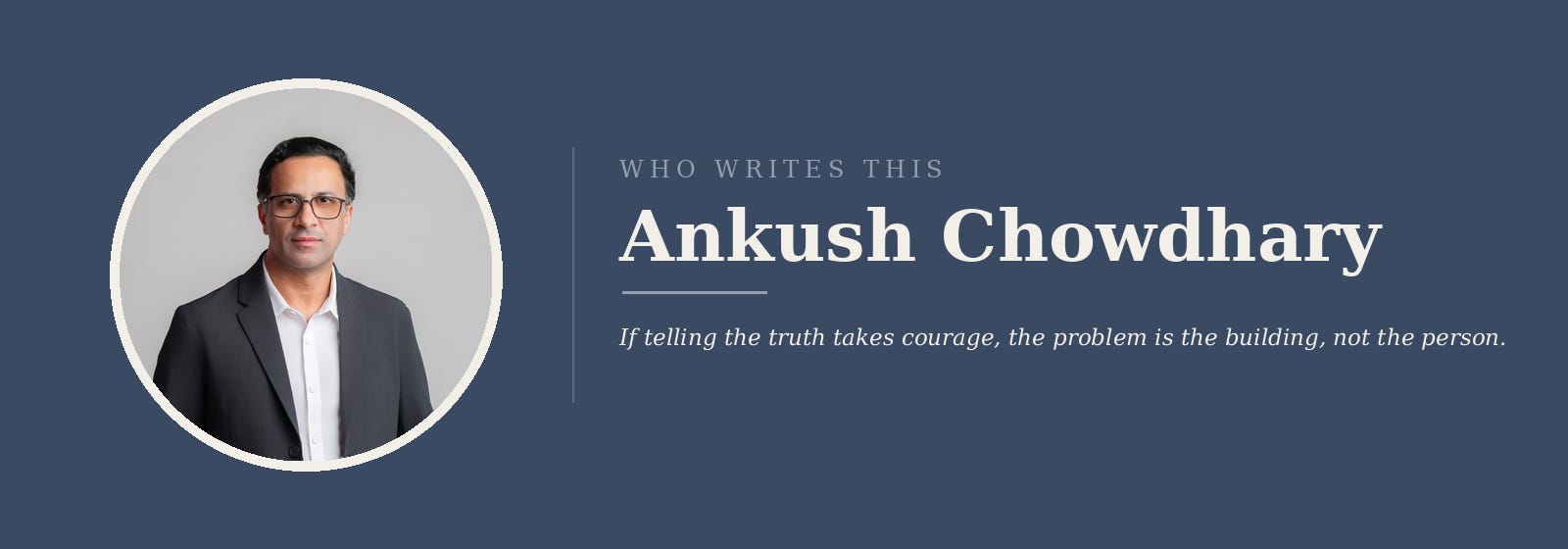
Who writes this
I’m Ankush Chowdhary. I’ve spent thirty years in cybersecurity inside the rooms where decisions get made and unmade and I wrote this because I lived it. For years I watched capable, honest people struggle and fail, and slowly understood what I was seeing: polar bears in a desert. There was nothing wrong with the animal; the environment was simply built to kill it. The variable was never the person. It was the structure around them. I wrote this for the person who is a polar bear in a desert right now, and still has time.
Subscribe to get it from the first issue one principle a week.
